

Bowling is an ancient sport and form of entertainment. Long before becoming one of the world’s most popular entertainment experiences, Bowling was already part of human history.
Archaeological evidence reveals that the sport emerged more than 5,000 years ago, crossing civilizations, cultures, and generations until winning over modern audiences as an activity that brings together fun, competition, and connection between people.
Millennia later, the social tradition of bowling remains alive around the world, bringing together families, friends, and communities around fun and social interaction.
See below the history of bowling and discover how it was born and transformed into what it is today!
Timeline: discover the history of bowling

5200 BC: It is said to have been found in Egyptian tombs, pins and balls from a set of primitive bowling. The game used balls made of a rock called porphyry, and 9 pins.
In Polynesia, an ancient game of throwing balls called “ula maika” is also considered as the origin of bowling. Another legend says that warriors of ancient tribes entertained themselves after battles, using the bones of their enemies, as the skulls were thrown by placing the fingers in the eye sockets.
1st Century: In the Roman Empire there was a game with the launch of stone objects.
3rd Century:
In Germany, one of the most popular activities was Kegelspiel, considered one of the ancestors of modern bowling. Germans positioned nine pins, called kegels, in a diamond formation.
In addition, bowling also had a religious meaning. Churches in Germany held bowling games. The nine pins arranged in a diamond symbolized heaven, while stones were thrown toward the pins with the goal of knocking them down. It was believed that the player who knocked down all the pins would be spiritually purified, absolved of sins, and would reach heaven.

In England, King Edward III prohibited the practice of 9-pin bowling because soldiers were playing Bowling instead of practicing archery, which was considered essential for military training.
Since the prohibition specifically targeted the 9-pin version, the English reinvented the game and began playing with 10 pins.

Middle Ages: Bowling was one of the favorite games between kings and soldiers. Even bowling was banned in some places and periods, so that soldiers could focus on their training. Bowling has spread across several European countries, both on grass and indoors. There are records in England, Germany, Austria, Switzerland and the Netherlands.
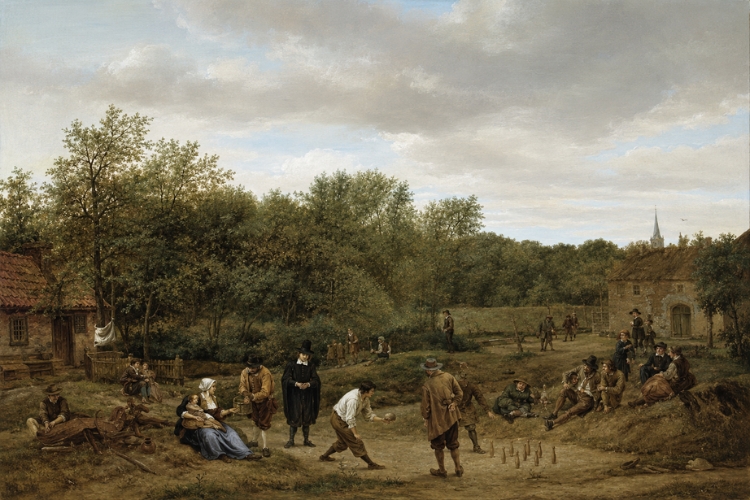

16th Century: In Germany, recreational games were part of social and community life, and bowling represented a moment of relaxation, friendship, and integration among the faithful. Historical records indicate that Martin Luther (1483-1583) played nine-pin Bowling in the gardens of his residence. Some historians also attribute to him contributions to the standardization of the sport’s rules and to the definition of nine pins, which later evolved into the current 10-pin format. The game helped bring people together, strengthen community bonds, and create spaces for dialogue outside the formal moments of the church.

19th Century: The ten pin bowling version, arranged in triangular form, was created in the United States, and then, in the twentieth century expanded to the world.
1895: The American Bowling Congress (ABC) was organized with the aim to standardize and improve the rules.

1930: To unite all bowlers in the world, came the World Tenpin Bowling Association.
1952: The FIQ (Fédération Internationale des Quilleurs) was founded as the international federation governing the sports of bowling and nine-pin bowling worldwide. The organization was later renamed World Bowling and is now officially known as the International Bowling Federation (IBF). It serves as the highest global authority and regulatory body for the sport.
The FIQ was created with the objective of unifying and promoting international amateur competitions, overseeing regional and world federations for the different variations of the game. Today, the IBF is the highest authority recognized by the International Olympic Committee and coordinates world championships, establishes the technical regulations for bowling lanes, and seeks to promote the inclusion of bowling in major multi-sport events.
50’s: Automatic machines began to appear to return the pins to their places for new throws. Before that, fallen pins were manually repositioned by people nicknamed “pinboys”.

2003: Imply® launches Bowling Lanes with innovative technology.
Now that you have discovered the history of Bowling, learn more about the technologies available in current equipment: https://imply.com/engb/bowling-and-entertainment/